
Reviews
Victor Fleming
USA, 1939
Credits
Review by Jenny Jediny
Posted on 18 October 2006
Source Warner Home Video DVD
Related articles
Features: 31 Days of Horror
Watching The Wizard of Oz for the first time in roughly eight years, that click of a switch from the grey dustbowl of Kansas to the saturated Technicolor rainbow of Oz struck me in its pivotal function as the signifier of fantasy for generations of children. The pure stretch of Oz devotion across the decades has not only canonized the film as a Hollywood favorite, but simultaneously created a cult classic that is difficult to approach in its reputation. And yet The Wizard of Oz pushes beyond the now musty tradition established by broadcast television stations annually running the film to rich childhood memories associated with not merely the joy of the Yellow Brick Road, but also the forgotten and diminished fears initiated by Dorothy’s journey through Oz and her encounter with quite possibly the witch of witches.
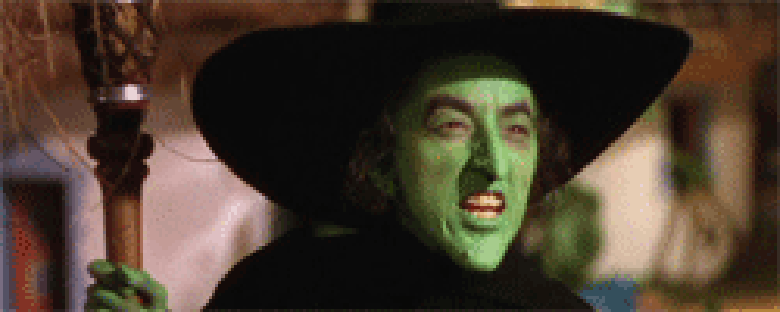
How appropriate that our villain is a witch, iconic symbol of not only Halloween, but also all-purpose evil. The Wicked Witch of the West, known in Kansas as Ms. Gulch, instigates our heroine’s fear by threatening to take away her dog, cruelty that even Dorothy’s guardians cannot prevent. Alone in her efforts to protect Toto, and later against the wailing tornado that will lift her away to Oz, Dorothy is the lost little girl whose dreams contain nightmares of her reality; in its furious swirl the tornado is intimidating enough without the slideshow of apparitions that float midair outside the house. After the chickens and fences fly by, Ms. Gulch appears, cackling as she transforms into the Wicked Witch—as the house hits the ground, the film not only blossoms into color, but becomes entirely rooted in Dorothy’s imagination (concluded from the implication that she has hit her head during the tornado and fallen unconscious). This unique aspect to The Wizard of Oz is often unnoticed in the blitz of songs that arise out of Munchkinland, and yet it allows for the binary split of good and evil in the film that is both utterly simplistic and yet universally familiar. Dorothy is baffled by Good Witch Glinda’s shimmering beauty, only to be reminded that only bad witches are ugly, hence the vibrant green facial hue of the Wicked Witch of the West, and the early association of evil with unattractiveness.
The Wicked Witch is not only hard to look at in this land of confectionary color, but she’s downright nasty. Appearing in a poof of burnt red smoke, she immediately demands to know who in Munchkinland has dared kill her sister, and Dorothy not only has to deal with the guilt of accidentally killing someone, but with a vengeful woman hell bent on revenge. The Wicked Witch practically barks, her harsh tone sending the Munchkins into hiding and Dorothy shaking in her new red shoes, but is sent off by Glinda, but not before warning Dorothy that she will get her. As in many popular fairy tales, Dorothy is not only on the run, but unwittingly given a quest, as sets off to find the mysterious Wizard who may be able to help her find her way home.
Oz is a perplexing place, but also wondrous. Consider how fantastic it is for a child (perhaps it personally was, if you watched the film in your most early years) to see inanimate objects spring to life and care for a lost girl. It’s an easy lesson in the power of friendship, charmingly displayed in the tight formation of arms akimbo Dorothy forms with the Scarecrow and Tin Woodsman as they anxiously march through a dark forest filled with — yes, repeat after me – lions and tigers and bears, oh my. The trio eventually surrounding Dorothy displays characteristics both gentle enough to associate them with childhood toys, but also protective instinct and knowledge that children desire in not only their parents, but also anyone they view in that nurturing role. What is frightening is not merely the black-cloaked stalk of the Wicked Witch as she encircles kidnapped Dorothy, but her threats to take away not only Dorothy’s life, but also the protective bubble of her family and new friends. This fear is what pushes Dorothy into action, as she watches her dear Scarecrow threatened with fire (still disturbing — it feels as violent as the Velveteen Rabbit threatened with a bonfire), and what ultimately destroys the Wicked Witch. Has there been a better death scene for a fantasy villain? The Wicked Witch shrieks like a banshee as soon as the water hits, and she is angry. Another “accident,” another wicked sister gone, as she twists violently and curses Dorothy, then simply melts into a black heap of rags on the ground. It is without intention, but Dorothy has certainly gotten her revenge on Ms. Gulch, and the horribly realistic and uncaring grown-up world, if only in her dreams.
Utterly determined, Dorothy does return to the grainy reality of Kansas, but not before unmasking the Wizard with his booming voice and suspended, gargantuan head. Oz really is a place where the little people — not the Munchkins — have power, and Dorothy’s juvenile state is celebrated, not seen as a burden nor irksome. Even the magic words that send Dorothy home have a mythic ring to them, reminiscent of a plea by a youthful boy to clap your hands and declare that you do believe in fairies. The Wizard of Oz, while embracing not only Dorothy’s hesitant moments of power, but responsibility, eternally belongs to the uncomplicated imagination of childhood.
We don’t do comments anymore, but you may contact us here or find us on Twitter or Facebook.