
Reviews / 10 March 2010

A Clockwork Orange

A Clockwork Orange
UK  /  1971

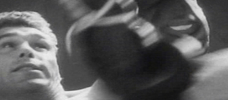
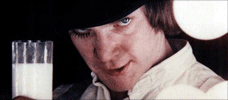
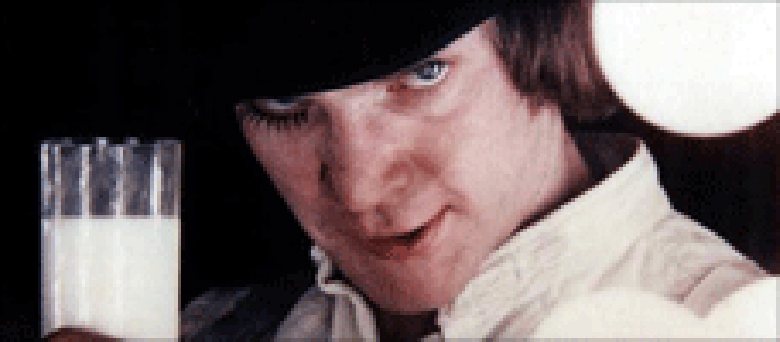
Does any film have a more entrancing, seductive opening than A Clockwork Orange? Here was Kubrick, after 2001, at the height of his cultural fame and recognition – in Joseph Gelmis’ terms, the ultimate Film Director as Superstar – and at the height of his control of the medium and of us. As an audience we’re mesmerised from the start, by the slow, slightly-distorted, slightly-disturbing strains of Purcell played on a Moog; the glaring primary-colour of the credit stills: bright red, blue, and red again; and the opening close-up on Malcolm McDowell—the young McDowell, at his most handsome, arrogant, and bewitching.

In that first close-up McDowell holds us in his gaze, staring out directly, brazenly into the camera, his heaving chest hinting at the barely contained violence. At the same time Kubrick exercises his own grip on us with the slow, controlled zoom-back that reveals Alex’s fellow droogs and the drugged-up spaced-out world of the Korova Milk Bar with its eroticised furnishings and brawny bouncers in white jumpsuits. And then there’s McDowell-as-Alex’s now famous voiceover narration:

There was me, that is Alex, and my three droogs, that is Pete, Georgie, and Dim, and we sat in the Korova Milkbar trying to make up our rassoodocks what to do with the evening. The Korova milkbar sold milk-plus, milk plus vellocet or synthemesc or drencrom, which is what we were drinking. This would sharpen you up and make you ready for a bit of the old ultra-violence.

And ultra-violence is what we get as Kubrick repeats the slow pull-out opening on the next two sequences, where Alex and his droogs first beat up an old drunk tramp and then stage a rumble with a rival gang. But already there’s a sense that something in this film is not working. By rights the drunk’s speech (on the lack of law and order, and on the lack of a place for the old in this “stinking world” ruled and abused by the young) should be a moment of authorial voice, where the identification with Alex that the film has posited so far can be called into question. The words are there, but Kubrick is simply not interested in following through on this. Surely, we would think, this is the moment when Kubrick pulls us back from this identification with Alex and, through the figure of the tramp, shifts the ground of the film’s argument, pointing to the human and societal costs of Alex’s “charm.” But this calls for a more complex and more profound film than Kubrick is prepared to offer us. Instead, he allows Paul Farrell as the tramp to subside into the usual grimacing he encourages from other actors in the course of the film (Aubrey Morris as Alex’s social worker Mr Deltoid, Patrick Magee as the wheelchair-bound Mr Alexander). And he very quickly moves on to treating in comic mode√¢ÔøΩÔøΩcue Rossini’s “The Thieving Magpie”—the gang rape of a young woman. Which is also a reminder that women in A Clockwork Orange – the young woman here, Mrs Alexander in the subsequent home invasion scene which itself is cued to McDowell’s parody of Gene Kelly’s “Singing in the Rain” – seem to be there to be stripped naked for the delectation of Alex, of Kubrick’s camera, and, forcibly, of the audience.

Kubrick declared serious intentions for his film. It was, he said, for example, to Michel Ciment, concerned with the central question of free will.1 So, when Alex is subjected to the government-run aversion therapy Ludovico Technique, which remodels his personality by suppressing his impulse to violence but which at the same time kills off his love of Beethoven, this is seen as a loss of his essential humanity—the ability to choose.

Two comments are worth making here. One is that with the film’s turn to broad political satire – the right-wing government minister who originally promoted the Ludovico Technique allows Alex’s return to his violent self as a cynical political ploy – Kubrick offers a banal and insufficient treatment of the problem at the core of the story: that is, how society deals with violence within it. A Clockwork Orange has nothing of the complexities explored, for example, by Krzysztof Kieslowski in A Short Film About Killing. Kieslowski’s work is thoughtful, deeply-felt, humane and moving in a way that A Clockwork Orange cannot even begin to approximate, and one thing Kieslowski is incapable of doing is to depict an act of violence as a joke, with a cynical smirk and a shrug. The murder at the centre of A Short Film About Killing is a long-drawn-out struggle, a spectacle that is made deliberately painful to watch. Here, there’s an interesting parallel with A Clockwork Orange, because just as Kubrick portrays Alex’s victims (think especially of the Cat Woman) as less-than-human caricatures in effect inviting the violence meted out to them, so you might think that the attack on the taxi driver is somehow justified by the foulness of his character. Except that Kieslowski refuses to allow that interpretation and asserts the humanity of the taxi driver and the value of his life at this moment of his death, just as he will with the young killer and his legally-sanctioned execution. Can we imagine A Short Film About Killing that focuses exclusively on the character of the young killer, building him up sympathetically and reducing all around him to laughable caricatures? No—but this is precisely what Kubrick does in A Clockwork Orange, a strategy that Kubrick signposts in the film’s second sequence when he abandons the drunk tramp, in spite of the implications of his speech, to his fate.

A second problem is how Kubrick has cherry-picked his theme from Anthony Burgess’ novel. Burgess was a writer whose Catholic beliefs were central to his work. He believes in original sin, the concept of a flawed, sinning – and, in Alex’s case, a violent – humanity that still has the potential to choose good. It is critical to Burgess’ conception of his novel that it originally ended on a final chapter (omitted in the U.S. version) where Alex through the conscious exercise of his own free will turns his back on his violent past.

I can’t say I have much interest in these religious themes, but it’s very clear that Burgess’ novel is a deep and resonant working-through of his concerns. Kubrick, on the other hand, is simply uninterested in the religious aspects of the work, so all he’s left with is an expansion on the banal political satire that was already present in the novel. Burgess also does a far better job of balancing Alex’s appeal with the establishment of a certain critical distance between Alex’s “voice” (the novel is his first-person narrative) and the reader. This is effected by Burgess through the creation of a Russian-influenced youth dialect in which the entire narrative is written. It’s literally a struggle to parse meaning out of the sentences and this creates a wall of language forming a barrier between Alex and the reader.

Academic writers like Thomas Allen Nelson or Mario Falsetto have attempted to argue that Kubrick has achieved a similar effect through his stylistic choices. Falsetto, for example, places a lot of stress on the “unusual tension between the dominant, subjective mode of presentation” [i.e. the engaging theatricality of Alex’s performance] “and the distanced, emotionally uninvolving stylistics of the film”2; and Nelson even suggests that the ultimate effect of Kubrick’s distanciation devices is to “[undercut] a mindless identification with Alex.”3 I’m not convinced by these kinds of arguments, which fall down in one crucial area: they either fall to address (Falsetto) or, it seems, fail to see (Nelson) what is for me the central problem of A Clockwork Orange, namely Kubrick’s total identification with Alex. I don’t imagine that this was a conscious strategy on Kubrick’s part but the result of a whole series of aesthetic choices—of actor, of music, of shooting style. There’s a sense that Kubrick lost control of his material because of his loss of the necessary critical distance. This is literally embodied in the many production stills you can find of Kubrick with his handheld camera sticking close to the rape and mayhem, appearing as one more droog in Alex’s gang. After establishing the narrative perspective as that of Alex, Kubrick’s treatment of his victims is the next inevitable step, whether he turns them into grotesques (Mr Alexander) or implies that they’re to blame for the violence meted out to them (the Cat Woman). In the total collapse of Kubrick’s artistic project, there’s nothing left for him but to end the film with a piece of knee-jerk cynicism (“I was cured all right!”)—pathetic, gratuitous, and unworthy of the great film artist that Kubrick undoubtedly was.


  1. Michel Ciment, Kubrick: The Definitive Edition, New York: Faber, 2001, p. 149.
  2. Mario Falsetto, Stanley Kubrick: A Narrative and Stylistic Analysis, 2nd ed., Westport: Praeger, 2001, p. 54.
  3. Thomas Allen Nelson, Kubrick: Inside A Film Artist’s Maze, expanded and rev. ed., Bloomington: Indiana U.P., 2000, p. 156.

Comments / 10 total / Submit Comment

  1. Adam
    10 March 2010
    11:14 AM

    I like Burgess but find that his army of meaty, splashy adjectives tends to flounder when it attacks his more “deep and resonant” concerns. At his best I find him invigorating and bomabastic but I think that the school-boy cynicism of the film has its roots in the written source material. Though I may just be a little soppy.


  2. just another film buff
    10 March 2010
    8:19 PM
    Website

    Whoa! A blatant dismissal of a film that I consider a masterwork! Very interesting.

    I, for one, do not think that the intention behind caricaturing the victims was to justify the violence. It was another way of alienating the narrative. And the handheld during the cat woman scene, IMO, was to suggest the madness of it all, a la in Lyndon, and not to rejoice or identify with Alex. And the film is an experiment and a critique on identification techniques where Kubrick comments on the manipulation of the audience itself.

    But I can empathize with your magnificently written review, Ian. Cheers!


  3. Charles Hamilton
    12 March 2010
    2:18 PM

    The film celebrates the violence of art in a world rendered impotent by the pomo aesthetic, which I why I think the reviewer is a put off by the ghastly violence. He fails to make a connection between Alex’s violence and art-as-violence.


  4. Oddzilla
    16 March 2010
    7:16 AM

    I find this, along with Nigel Kneale’s ‘Year of the Sex Olympics’, made around the same time, to be remarkably prescient. One needs only to read the newspaper each day to read stories that mirror the exploits of Alex and his cohorts or switch on the television to witness an endless stream of banality masquerading as entertainment being pumped at you as if from a severed artery. Any number of politicians today would fall on the Ludovico Technique as manna from heaven were it available and use the same mantra of “It works” as if that were ample justification. Another aspect of this is the exterior look of the film where the tower block accommodation and the urban municipal spaces, which would have been brand spanking new at the time of filming, are depicted as looking neglected, having been left to deteriorate. As far as the aesthetic of ‘A Clockwork Orange’ goes, amorally depicted violence amid a lurid Pop Art setting was pretty much de rigueur in certain types of film from the mid sixties until the early seventies and in the vast majority of these films, this violence has no consequence. In this instance it obviously does albeit in sardonic fashion. If Kubrick was commenting on this trend or merely being modish is for the viewer to decide although judging by his other work, I prefer to think the former to be the case. Whether or not the last chapter wasn’t filmed simply because, as he claimed, Kubrick hadn’t read it (I think it unlikely) or by design, it is the only point in the book where Alex shows any trace of anything other than malicious self interest and it’s omission renders him a completely unsympathetic character, impossible to identify with and therefore no less a caricature than any others in the film. It’s this feeling of real world violence perpetrated by both the individual and the state gate crashing a day-glo Carry On film that makes it all the more affecting.


  5. Vivian
    16 March 2010
    10:01 PM

    You lost me at “a sense that Kubrick lost control of his material.” You should know better than that. No one has ever had more control over their material than Kubrick. Your judgments seems based more on moral and political grounds than aesthetic. That’s a shame.


  6. Leo
    17 March 2010
    9:32 AM
    Website

    Vivian: I don’t see what the big shame is. Kubrick’s film has some pretty clear (and some less clear) moral and political ideas in mind, so why not judge it on those grounds? I think the whole point of Ian’s piece is that the aesthetic mode in which Kubrick addresses these points undercuts or even perverts the moral and political arguments he would seem to be making—and I, for one, agree.

    This also speaks to Oddzilla’s point about the character of Alex. Oddzilla describes Alex as “a completely unsympathetic character, impossible to identify with,” but I personally don’t think there is a more charismatic, more fun, more easily to relate to character in any of Kubrick’s films. This indeed may have been part of Kubrick’s subversive strategy, but it’s at very least problematic, even if deliberately so. Of course, in nearly all of his films, Kubrick likes to play with the audience’s sympathies and identification with the protagonist (Humbert Humbert, HAL, Redmond Barry, Jack Torrance, Bill Harford). But here, even if I think the film interesting, I don’t think it works nearly as well.


  7. Leo
    17 March 2010
    9:34 AM
    Website

    Also, Charles, I’d love to hear more on what you think is the connection between Alex’s violence and art-as-violence, or indeed what art-as-violence is.


  8. Ian
    17 March 2010
    8:10 PM
    Website

    Well, Leo has already sprung to my defence, whose points I’d only repeat. Vivian, my feeling with A Clockwork Orange is that Kubrick’s vaunted control at a production level and his favoured distanced objective eye over the proceedings of the narrative collapse, seduced as we are by the character of Alex. Which is where, like Leo, I take issue with Oddzilla — from the first scene to the last we are being made to empathise and identify with Alex; if there’s a subversive strategy here, then it’s a failure. And Charles, I’m also intrigued as to what art-as-violence might be.


  9. Charles Hamilton
    18 March 2010
    11:33 AM

    I’m not sure if I’m allowed to post weblinks here, but if you type “Kubrick Corner” into google and click the first link you will see an article which I believe is called “The Aestheticization Of Clockwork Orange” which I think you might find interesting.

    Anyway, the point I was making earlier is that in Alex’s postmodern future, all art has been thoroughly commodified, removed of all context, rendered impotent, every object cut, copy and pasted ad infinitum. It’s Baudrillard’s 3rd third order of simulacra, the world already a stage, a film set, a cat walk, a simulation, with everyone pretending/mistaking this structuring (cultural) fantasy for “common sensical” quotidian reality.

    In this Clockwork Future, art is now devoid of any significance or meaning. In all its excess, it now either serves as decorative titillation and masturbatory material for over-excited voyeurs, or empty décor, barely noticed despite its omnipresence. In short, it’s Frederic Jameson’s postmodernism run rampant, all cultural objects turned into empty signifiers, cut loose from any power to communicate.

    “The Killing” made several comparisons between gangsters and artists (“I’ve often thought the gangster and the artist are the same in the eyes of the masses‚Ķ” one character says), and here Alex becomes a similar figure, the artist/criminal who, in a kind of libidinal frenzy, seeks to reassert the power of art. His ultra violence, goes beyond the passive violence of the world to reinvigorate all art he touches.

    In this regard, the Droogs are always engaged in performance, all violence in the film is staged as a show or song-and-dance-number, often followed or preceded by applause. Likewise, their speech is theatrical, there is a focus on costumes and the eye and all the sex and violence occurs in theatres or on stages (much like every scene in Barry Lyndon focuses on games of chance, cards, duels etc).

    There are a couple other layers. Firstly, “A Clockwork Orange” is also a Ludovico film on its audience, all the signifiers found in Alex’s treatment “bleeding” off into the picture proper, secondly Alex (who wears a crown of thorns during his treatment and is mirrored to the dancing statues) is treated as a Christ figure who’s death and rebirth heralds the rebirth of the creative/human spirit. (Note he keeps a pet serpeant: in Genesis, it is Satan, in the Garden of Eden myth, who brings intellect to man thereby shaking him out of his clockwork slumber). Thirdly, the entire film is told from Alex’s drug fuelled gaze (the film makes constant references to eyes). It’s how he sees himself and his world (all the women are either sexually attractive and look the same, or wear the hair style of his mother), and so the film’s narrator is wholly unreliable.

    Incidentally, why does nobody criticise Lolita for portraying a likeable paedophile? Is it simply because we don’t see any overt sexual activity between Humbert and Lolita? Why do we accept that film’s unreliable narrator?


  10. Leo
    18 March 2010
    1:21 PM
    Website

    Curiously, Katherine Follett’s piece on Lolita in this feature actually does criticize the film on those grounds, and indeed the cases are similar. In both cases, Kubrick is adapting a literary work in which the gulf between what the narrator tells us and what the author is implying is fairly large, and both Ian’s and Katherine’s reviews seem to take Kubrick to task for losing this nuance—or at least failing to translate it into cinema. I would say I agree with both Katherine and Ian to a certain extent, though I think this may say more about the difficulties of this kind of adaptation than any particular failing of Kubrick as a filmmaker.

    But Kubrick, ever the self-aware auteur, seems to be thinking about this problem, too: immediately, with Barry Lyndon, he reverses the scenario of the prior film, giving the narrative authority over entirely to an unreliable omniscient perspective whose framing of the story seems to work against the protagonist. The challenge here is almost the opposite to his “unreliable narrator” films: here it is narrative itself that is unreliable, and the pitiable protagonist its victim. This is further played out in The Shining, where the author himself is the protagonist who gets rewritten into the history of the Overlook Hotel, a more powerful narrative force, and in Eyes Wide Shut, where there remains the question of who is in control of the narrative—are the events of the narrative being directed (perhaps by a character played by a real-life director) or are they simply random coincidences? (The monoliths in 2001 can also be interpreted as ways in which an alien intelligence redirects the narrative of human evolution.)

    In any case, many thanks for the thoughtful response, Charles—much to chew over there. And, incidentally, you certainly can post links here. I think the article you refer to can be found here. I’ll be sure to check it out.


Submit Comment / Some HTML is OK / Preview your remarks below


Preview Comment

Credits

Directed by
Stanley Kubrick

Review by
Ian Johnston

Source
Warner Bros. DVD


Categories


Statistics

Posted on
10 March 2010

Read
2157 times

Comments
10

Jump to comments
Submit comment

Recent Updates