


Reviews
Moartea Domnului Lazarescu
Cristi Puiu
Romania, 2005
Credits
Review by Leo Goldsmith
Posted on 21 September 2005
Source Mandragora Movies 35mm Print
Related articles
Features: The 43rd New York Film Festival
Any film that anticipates its protagonist’s demise in its title is bound to inspire a certain amount of impatience. The Death of Mr. Lazarescu, however, is patient in the extreme, dutifully rendering its title character’s final hours as he tours the emergency rooms of Bucharest’s hospitals.
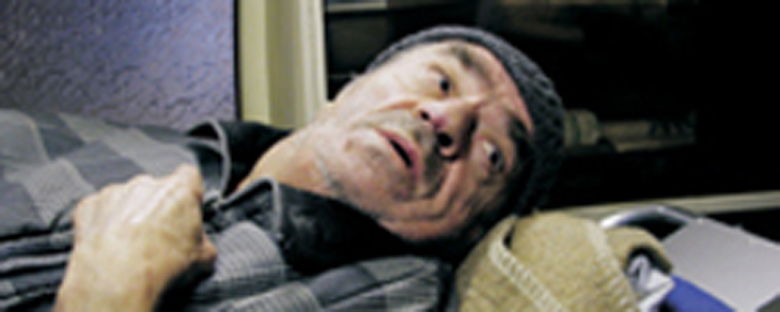
Dante Remus Lazarescu is an unlikely hero, and his odyssey is far more banal than his absurdly epic name would suggest. A 62-year old widower given to heavy drinking, Lazarescu subsists on cold-cuts and cheese in a lonely, feline-ridden apartment, borrowing money from a distant brother-in-law and feeding upon the cautious good graces of his neighbors. When the day of his death arrives, Mr. Lazarescu telephones for an ambulance, waits nervously for its long-delayed arrival, and is then whisked off into a nightmare of Romanian healthcare. As our hero drifts in and out of consciousness and closer to departure, his long-suffering ambulance attendants shuttle him through a succession of overworked and understaffed hospitals. The night wears on and Lazarescu’s condition becomes increasingly dire as they encounter a series of increasingly jaded, condescending, and exhausted medical staff who find every opportunity to gossip, moralize, and quibble over bureaucratic code before shunting the patient to another hospital.
Invoking Rohmer’s Six Moral Tales, the press packet for Lazarescu declares the film as the first in a projected series of six films on the different forms of love—romantic, sexual, filial, and so forth. The present entry in the cycle is purportedly Puiu’s meditation on the love of humanity, but this proposition is reinforced more by the absence of such love in the film rather than its presence. What small measure of humanistic love one can find in the film often devolves into fussiness (as in the case of Lazarescu’s neighbors) or else is worn away to apathy (as very nearly happens to his attendant nurse, Mioara). Instead, it is the viewer who must supply the bulk of the empathy, not only for the pitiable Mr. Lazarescu, but also for the petty, well-meaning, prideful, and cynical characters that shepherd him to his inevitable end.
The realistic style of the film is close to becoming a film festival and art-house cliché, marked by a perpetually tripod-less cinematography, scenes that play out in real time, and a somewhat wearying duration. But as familiar as these devices are, the style is never bludgeoning, and in any case, it is hard to imagine that this film could have been constructed in any other way. The length and pace of the film coercively situate the audience in Lazarescu’s position (and later, that of the nurse), locking the viewer in the cinematic equivalent of a hospital waiting room. But although the result is mounting exasperation, the overall mood is alleviated by the slightest and blackest of comedy. And when the film’s title is finally, quietly realized, it affords the viewer a hard-won, if mournful liberation.
We don’t do comments anymore, but you may contact us here or find us on Twitter or Facebook.