


Reviews
Richard Kelly
USA, 2001
Credits
Review by Rumsey Taylor
Posted on 14 February 2005
Source Fox DVD (The Director’s Cut)
Of the numerous subgenres indigenous to ’70s cinema, the Head film seems to be the one that has spawned the fewest iterations. In the earlier part of the decade, efforts from Alejandro Jodorowsky and Dusan Makavejev became renowned for a stubborn lack of coherency and visual audacity. Some of their films even played for entire years on midnight circuits. These films were cult staples, many with a longevity that exceeded the decade’s more conventional films. With the end of the decade (or, perhaps, upon the release of David Lynch’s Eraserhead, the most durable Head film) came the subgenre’s disintegration.
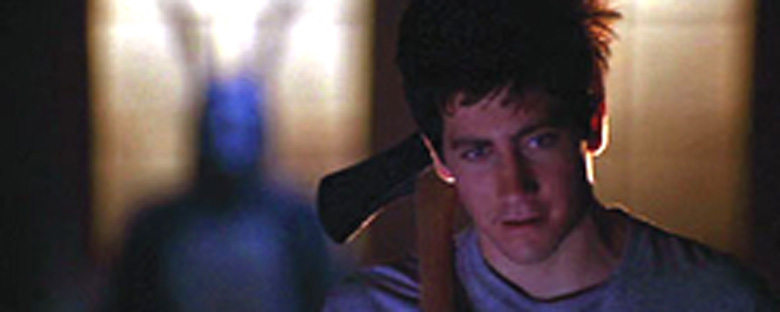
I cite this defunct trend not to elevate the status of Donnie Darko via comparison, but rather to delineate its primary ancestry. It is in this regard that Donnie Darko’s peculiar popularity is described, as it has been received in the same manner as a Head film. The film has become a cult staple on video (along with Office Space, this was one of Fox’s bestsellers in its original, now truncated form), and, significantly, has been available in midnight screenings for much of the time following its lackluster 2001 release, at least in New York and Boston. With this sort of cult audience, a film’s criticism is rendered moot; evaluation, in turn, becomes an effort to contextualize such appeal.
In retrospect, the ’70s’ wealth of cinematic oddities pales considerably the sort of cult films that have burgeoned in the past ten years. It’s disingenuous to compare something like Office Space or Fight Club (even with the loose implication of “cult”) to anything that gained renown on the midnight circuit thirty years ago, films that introduced few recognizable actors other than Dennis Hopper, black cowboys (this would be 1969, to be precise), and porn chic. These incompatible, disparate qualities define the decade, and it is the same disparity that qualifies Donnie Darko as an appropriate resurrection.
Its individual merits are, however, entirely derivative. The film is set in the late 1980s, for no other apparent reason than to employ nostalgia (I would ignorantly suspect that the bulk of the film’s cult audience grew up in the decade). Its power soundtrack verifies Richard Kelly’s Hughes-ian aesthetic, and his stuttering steadicam shots are lifted from Martin Scorsese—one of the final shots in the film, even, is noticeably similar to the final shot of Krzysztof Kieslowski’s Blue. None of these elements in themselves characterize the film, but it is their combination that aggregates the film’s signature mystique.
Due to the massive audience that graced its availability on video (only in the UK did the film find a receptive audience in theaters), Donnie Darko is now available in an expanded director’s cut. The mystique of the film—which I consider engaging despite my many criticisms—is burdened by further explanation. The answers are still not evident, but now the questions are more pronounced. At some point interpretation becomes not the task of a film’s director but it’s audience, a thought exemplified in this film and dummied by its longer cut—one inherently prone to scrutiny. I’ve seen both versions of this film, and I can see Richard Kelly’s talent at juggling. His work is not an original one, but it is a faithfully rendered head trip.
We don’t do comments anymore, but you may contact us here or find us on Twitter or Facebook.