


Reviews
Norman Cohn & Zacharias Kunuk
Canada / Denmark, 2006
Credits
Review by Leo Goldsmith
Posted on 17 October 2006
Source Kunuk Cohn Productions 35mm Print
Related articles
Features: The 44th New York Film Festival
If we are to adhere to the credits of the film literally, the full title of Norman Cohn and Zacharias Kunuk’s follow-up to their enormously successful film, Atanarjuat: The Fast Runner, is actually A Series of Events Reported in the Journals of Knud Rasmussen. This is notable for two reasons: first, because the film strives toward a documentary realism with its use of handheld, DV cinematography; second, because very little of the film is actually narrated from the title figure’s perspective.
Born in Greenland to Danish parents, and of one-quarter Inuit extraction, Rasmussen makes for an ideal historical figure through whom to tell the story of cultural interaction in Arctic Canada in the early twentieth century. As adventurer-anthropologists of the time go, Rasmussen is an unusually sympathetic figure from a modern, cultural studies perspective, and his ethnological insights into Inuit history and folk culture provide a suitable frame through which Cohn and Kunuk can view the complex (and mostly tragic) fallout of the Inuits’ encounter with Euro-Christian culture.
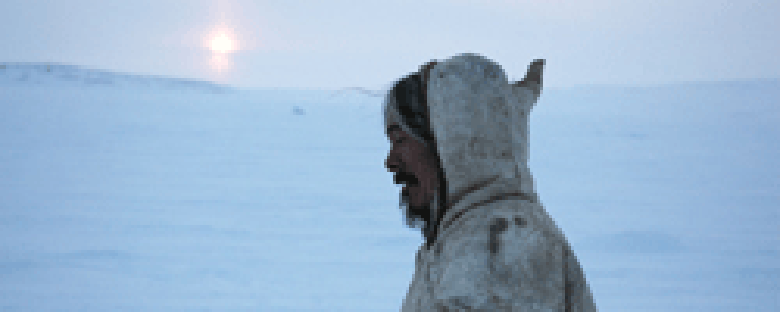
Opening with a static shot of an Inuit family assembled in their sod-hut, we are almost immediately plunged into a world very different from the folkloric universe of the filmmaking team’s previous film. The blue, white, and gold-flecked world of ice outside is largely the same, as is the constant struggle for food and shelter, but this seemingly elemental way of life now has further complications, as noted by the background crackle of a gramophone playing Caruso, the singing of hymns, the puffs of tobacco, and some well-practiced handshaking. Sooner than one might expect, white men enter the film, with maps and scientific instruments in hand, asking for directions to a remote island in the Inuits’ own language, Inuktitut.
For The Journals of Knud Rasmussen documents the Inuit world after the fall, and not the encounter itself. (This is one of the many differences between this film and Malick’s The New World, a film that is superficially similar in its themes, though quite distinct in its aspirations and style.) This is not a world that dogmatic Christianity is about to taint; unlike Nick Ray’s The Savage Innocents, Cohn and Kunuk’s film portrays an Inuit world in which this tainting has already begun. So, when Rasmussen and his men enter this sod-hut, seeking help from Avva and his family, the Inuits are more than a little wary. Avva, a strong silverfox of a patriarch with shamanistic powers, has seen more than one of his contemporaries succumb to the cozy promises of a pleasant afterlife with Jesus and is determined to keep his family free of the influence of the insidious white culture. But in spite of this, Avva and his family relent, swayed by the good intentions (and fluent Inuktitut) of Rasmussen and his men.
That this decision ultimately ends badly for the Inuit family unit is almost a foregone conclusion in a film like this, but it is worth pointing out that the filmmakers do not wish to fully implicate Rasmussen and his men in this fate. Indeed, the explorer’s anachronistically earnest endeavor to investigate and record the last remnants of Inuit culture is perhaps the film’s primary concern, as evidenced by the emphasis placed upon recording devices and the voiceover narration of Avva’s daughter, Apak (which was presumably pulled verbatim from Rasmussen’s notes). The filmmakers’ intent seems not to incriminate ethnographic missions like Rasmussen’s, but rather to complete them, here using a mode of filmmaking that playfully toes the line between historical film and cinéma vérité. Inuit characters look directly back into the camera and, in one interesting moment, even bump into the camera while demonstrating a traditional dance inside an igloo. The implication here is that we are watching not only “a series of events reported in” Rasmussen’s journals, but also their modern recreation in DV some eighty years later.
Artfully, Cohn and Kunuk extend this odd mixture of styles throughout their entire film. Notably, the filmmakers cast the “spirits” that often visit the characters as flesh-and-blood participants, rather than treating them like ethereal beings, exploding the boundaries between the realistic and the fantastic. On a more concrete level, Cohn and Kunuk devote great swatches of the film to the portrayal of Inuit customs and social practices (discussions about marriage, the spirit-world, one’s place within the family, and the taboos surrounding eating meat) and to the contemplation of the blinding sunlight of the Arctic landscapes and the way that light bleeds softly through the walls of igloos. What is most interesting about these parts of the film is that lengthy stretches of dialogue and rituals remain untranslated and unglossed, seemingly suggesting that part of the advantage of modern filmmaking over Rasmussen’s notation is the former’s ability to present social practice without the mediation of language and interpretation.
This constant emphasis on the differences between the 1920s anthropology of the collector and the resuscitative anthropology of modern videomaking makes The Journals of Knud Rasmussen a fascinating, multifaceted historiography and autoethnography, even if its story of cultural imperialism offers few new insights. The story of Avva and his family’s loss of their belief system to Christianity, coupled with the forfeiture of their shamanistic connection to a very tangible spirit-world, provides endless fascination, carried principally by the performances of Pakak Innuksuk and Leah Angutimarik (who play father and daughter, respectively). But the fascination is less one of emotional engagement than one of visceral integration; in the hands of Cohn and Kunuk, we are not necessarily asked to understand or identify with the Inuit world as enter and interrogate it, like the spirits who wander in and out of the frame as silent, but deeply implicated observers.
We don’t do comments anymore, but you may contact us here or find us on Twitter or Facebook.