


Reviews
Sofia Coppola
USA, 2006
Credits
Review by Jenny Jediny
Posted on 25 September 2006
Source Columbia Pictures 35MM Theatrical Print
Related articles
Features: The 44th New York Film Festival
During the journey from Austria to France, Marie Antoinette rides in her carriage, playing cards with her female companions and repeatedly looking at the only picture she has of her future husband, Louis Auguste, a painter’s sketch given to her in locket form. At one point the princess leans upon the glass and blows against it, and in a familiar gesture, traces with her finger through the fog, looking very much the lost little girl. Sofia Coppola has assuredly eradicated any notion of Marie Antoinette as untouchable historical figure; the Queen nurses a hangover, loves her dog, gets guilt trips from Mom, and finds stress release through shopping. A lot of shopping. Coppola, whose niche has become the trials of female youth, clearly conveys that Antoinette really was “just a girl” but accomplishes and explains little else in this disappointing film.
Adapting Lady Antonia Fraser’s biography Marie Antoinette: The Journey could not have been an easy task; Fraser’s bio is daunting in its detail and excruciatingly researched historical facts, but also takes great care to strip away the stereotypes that have plagued Marie Antoinette for centuries, from the young princess being an Austrian spy to uttering that infamous phrase concerning cake. The approach inspired Coppola, who has been quoted in interviews claiming she did not want to make a “dry, historical epic,” and “wanted to make an impressionistic portrayal of these characters.”
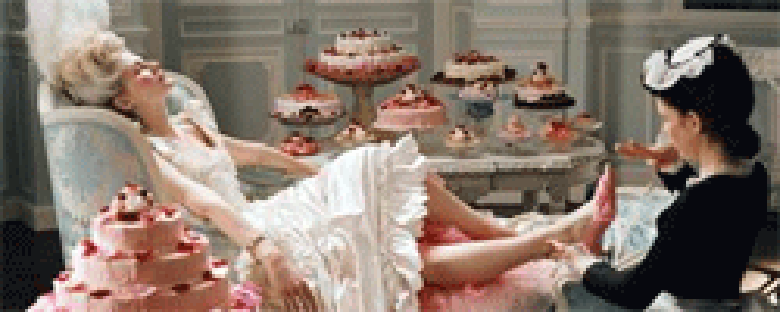
Marie Antoinette takes this notion and meanders with it. Undoubtedly, an impressionist portrait is one of the most fascinating approaches to a figure whom we will never know. All we have of Antoinette are preserved pieces of history, such as letters that may have been censored by the Queen herself, aware of the scrutiny she was under, and her fashion “look books,” featuring pinpricks made by Antoinette to indicate to servants the attire she wished to wear that day. The film hinges on these personal details, almost entirely avoiding the reality that occurred outside Versailles, until the French Revolution was literally beating down the door. The Palace of Versailles is sumptuous: aside from filming on the actual grounds and inside the Baroque palace, Antoinette’s wardrobe is incredibly well designed, from the Manolo Blahnik shoes to the plush silk gowns, bringing the court of the 18th century very much to life in eye-popping detail.
Coppola makes it very clear that Antoinette was not only passed into marriage as a pawn, but as a painfully naïve, uneducated and immature teenage girl. Antoinette moves through Versailles as the new girl in high school, with whispers following her every step and gossip building surrounding her Austrian background and unconsummated marriage (Louis, just as naïve as Antoinette, is confused in the bedroom). However, with her coronation as Queen, Antoinette quickly becomes the “It” girl, and fills her days and nights with shopping, all night ragers, and a devoted entourage. Coppola’s decision to constitute this lifestyle as the crux of her film, as well as provide a soundtrack of modern music, ranging from Gang of Four to Aphex Twin, has been touted as rebellious, a radical approach to the historical biopic. However, the music doesn’t feel out of place so much as gratuitous at times. Moments, such as the masked ball at the Paris Opera House, scored to Siouxsie and the Banshees, work in the film’s favor; it looks and sounds sexy, and successfully conveys the idea of Antoinette as a party girl, albeit a disguised celebrity. Even the use of The Cure’s “Plainsong,” in abbreviated form, compliments the coronation ceremony, segueing into New Order for the new Queen’s 18th birthday celebration. The music works stylistically (far more than the touted appearance of the Converse sneaker) but fails to go beyond the film’s elaborately constructed façade.
The notion of the film or Antoinette herself being rebellious through anachronism alone seems quite illogical. Filmmakers have failed to use proper accents before, and Derek Jarman even brought a typewriter into the 17th century world of Caravaggio. As far as Antoinette herself, her radical actions seem to have been limited to the world of fashion. Marie Antoinette isn’t trying to answer questions about its Queen and isn’t obligated to do so, but it doesn’t provide a clear argument of its sympathy toward the girl either. Yes, the film is about teenagers in Versailles, but they are ridiculously privileged ones who remain degrees apart from the wealthy socialite brats of today. An individual such as Antoinette was in fact in charge of a country, and one that was starving and infuriatingly angry with its government. It isn’t necessary to delve into the French Revolution, and the lack of the guillotine didn’t bother me in the least. But if this is indeed a focused observation on the simultaneous innocence and folly of the young Queen, the third act involving the marching on Versailles might have been eliminated altogether, along with Coppola’s attempts to pity Antoinette, whether using close-ups to capture her weeping behind closed doors, or her adolescent frustration when her lover, a Swedish soldier, leaves her for the battlefield.
Following the screening, Gus Van Sant’s Last Days occurred to me as a possible comparison or even companion piece to this film. Unlike the figure of Marie Antoinette — with whom I am very familiar — I actually have very little knowledge of Kurt Cobain, and barely know Nirvana’s music. Yet Last Days left me haunted, and connected to the film in a way that didn’t leave any gaping need for questions or answers. Marie Antoinette left me empty, with far less sympathy for the Queen than I had reading Fraser’s bio. For all the pomp and circumstance, Coppola’s interpretation is so simple it threatens to fall apart at any moment, and never congeals into anything beyond a beautiful, hollow sketch.
We don’t do comments anymore, but you may contact us here or find us on Twitter or Facebook.