


Reviews
Alfred Hitchcock
USA, 1960
Credits
Review by Rumsey Taylor
Posted on 11 July 2004
Source Universal Studios DVD
Psycho opens with the caption “Phoenix, Arizona … Friday, December the Eleventh … Two Forty-Three PM.” In this — the first slasher film — the specificity of location lends the film a truth. This convention functions to make otherwise clichéd horror mechanisms seem real, as they are given a ridiculously specific context. (Only Halloween benefits from its specific time and setting, borrowing from the macabre related to the titular holiday.)
The title credits of Psycho, the esteemed work of graphic designer Saul Bass, appear, and are divided horizontally — they are slashed apart. The visual corresponds with the film, its murders performed with a slicing butcher knife.
Psycho is a film with a distinct sexuality. Norman Bates appears to be an odd, nervous, and harmless individual, although his perversions (spying on Marion as she strips, his fascination with taxidermy/death) are affrontingly sexual. He sustains the presence of his mother with his hobby (and thus their relationship), and his personality is divided between himself and his mother’s, which he creates; he is both male and female. One half is aroused by Marion, the other repulsed by it. Norman fosters conflicting sexual roles.
However, “mother’s” crimes serve a double cause as they displace sexual impulses in the only way that will satisfy both personalities in Norman. In mother, murder reinforces her relationship with her son. For Norman the murders resemble intercourse, and are the most intimate sexual exchanges he has.
Psycho is not sexually exploitative despite its sexuality, though, as the title suggests, psychologically. The film forces its audience to spy, to be a voyeur (this is noticeably and subtly repeated from Rear Window). The establishing shot opening the film pans and zooms towards an open window, and the view enters the room. Inside are Marion Crane and her boyfriend, both in their underwear. The scene is tame by contemporary standards, though excluding its contemporary affects, we are still witness to what is an exclusive and intimate exchange between a couple. This idea is at play in numerous, other slasher films.
There are two shots that follow that reinforce our voyeurism: firstly, Norman spies on Marion through a peephole (the shot is an obsessive close-up of his eye); second, after her murder we see another, similarly intimate close-up of Marion’s eye. The first signals the audience’s position as voyeur, the second of killer. In this visual manner, Psycho is purposefully an exploitation film.
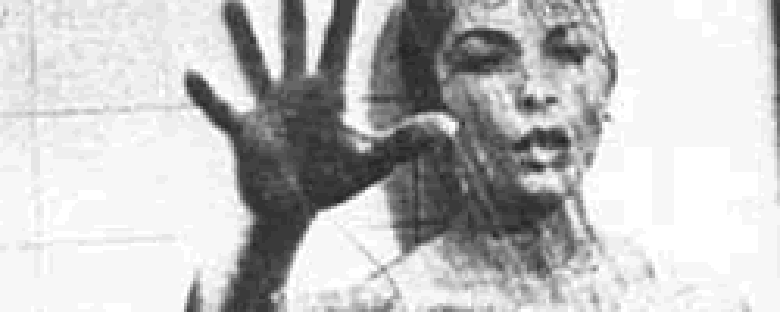
At its initial release Psycho was burdened by censors, who forced an edit of the infamous shower scene, darkening the lower half of the frame (although careful sights will see no nudity). Psycho was cited for its obscenity. Crane in her brassiere in two scenes prior to her staying at the Bates Motel. Furthering the claim, it is said to be the first film containing a flushing toilet, violating previous filmic ignorance of the existence of bathrooms. These elements combine to make the film obscene; as many have said, watching Psycho elicited guilt in its viewers. According to critic Danny Peary:
“It wasn’t the sex and violence alone that unnerved us, but — and this is what people usually forget — that we felt guilty about watching the sex and violence.”
We don’t do comments anymore, but you may contact us here or find us on Twitter or Facebook.