

Stalker

Credits

Directed by Andrei Tarkovsky

Review by Rumsey Taylor

Source Kino / Ruscico DVD


Statistics

Posted on 25 November 2006

Read 1040 times

Comments 6

Jump to most recent comment

Submit comment


Advertisements


Stalker /  Russia  /  1979

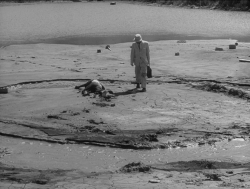
Stalker opens in a dilapidated, sepia-toned urban locale. The walls are all made of splintered wood, the floors creaking and giving way as someone walks on them. Dogs are whining, and the air is damp and dirty—everything is worn and depressed. Herein we find the stalker and his wife engaged in a ritual spat in an abode strewn with countless books and bereft of any contemporary technology. He moves outdoors but the environment remains oppressive. There is no fresh air, no new ideas, no freedom.

He enlists two men: a professor and a writer, both of whom seek entry into the Zone. It is a segregated environment that contains a room prophesied to fulfill their greatest wishes, and the stalker possesses the rare ability to lead them through it. Both men share similar motives: the writer seeks inspiration, the professor seeks discovery; both are essentially seeking knowledge. This is an unromantic and practical motivation, but the stalker warns them to follow him closely, for the Zone is an unpredictable and dangerous place, even if sparsely inhabited, and even those who found entry into the Room returned with new and greater despairs.

The focus is solely on the internalized motives of these characters. Despite this, Stalker remains a lucidly visual film: having followed the stalker through an army-regulated barrier and on to a handcar, the film’s palette changes at this instant—the monochrome opening is replaced by lush, organic blues, greens, and browns as the three men cross into the Zone. This transition is relayed with little revelation. On the aforementioned handcar, the scene (which is silent, save for the rustle of the rusted train wheels) is comprised of static shots that frame each man’s profile. There is the impression that any motivation or enthusiasm is matched, if not surpassed, by trepidation, the visit engaged not only by the potential for discovery, but also out of desperation and fear.

All three men retain their anonymous titles throughout the film, and the furthered descriptions of each — revealed intermittently during their search of the Room — fail to adequately personalize them. (It should be noted that the semi-derogatory English connotation of the word “stalker” is not intended in this film.) They instead remain archetypes. The writer speaks of his difficulty in writing, the professor of his frustration in research. They are skeptics. The search for the Room is a sort of pilgrimage; reaching it will affirm one’s faith, and it will also — in turn — disable any utility for hope. As, in this environment, hope is among the only tenets on which one may subsist, the collective loss of such is the greater risk—the discovery of the Room, the professor and writer fear, would lead inevitably to its exploitation. On its threshold the professor procures a bomb that will destroy the Room, depriving their revelations under the pretense of sustaining hope in the large remainder of those who have not entered it.

Description of Andrei Tarkovsky’s Stalker encourages genre categorization as science-fiction, a trait that also misappropriates his 1972 Solaris. This is chiefly attributed to a monologue late in the film delivered by the stalker’s wife, in which she infers that he is not human. (Their daughter possesses curious extra sensory ability as a result of her father’s inhuman genealogy.) This characterization — relying almost entirely out of inference and not example — may be extended: the writer and professor exude essentially human faults in their failure to enter the room, and it is of note that the stalker does not share these faults. His reasoning for leading them through the Zone is predominantly one of authority—in the Zone’s most dangerous leg, he issues the professor to go first; the insistence implies that he is protecting himself, and furthermore that he perceives his company to be the more expendable.

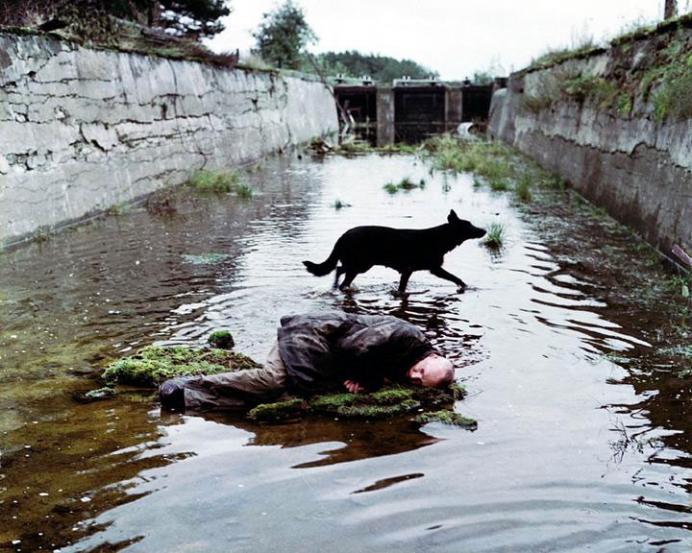
Close-ups throughout Stalker compose pollution and decay, concrete or metal constructs rife with water contaminated with some manufactured chemical substance—in the shot that precedes the epilogue, a goldfish may be seen swimming adjacent to what has the appearance of a swelling cloud of ink. This motif of decay is manifested in the film’s making: it was shot in proximity to both a hydroelectric station and a chemical plant, both of which (Vladimir Sharun, the sound designer, recalls in an interview on the Kino disc) contaminated waters in the surrounding region. Midway through the film, the three men enter the elongated, sewer corridor that leads to the Room. It is dripping wet, and portions of it are entirely submerged, which all three men proceed to traverse. Given Sharun’s thoughts, the Zone’s toxicity may not have been merely fictional—seven years later, Andrei Tarkovsky would die of a particular form of lung cancer, one that also led to the deaths of his principle acting talent Anatoliy Solonitsyn, the writer, in 1982, and his wife, Larisa, in 1998.

Comments / 6 total / Submit Comment

  1. Tyree / 30 November 2006 / 3:20 PM

    It’s interesting that you attribute the word “authority” to The Stalker for leading the other two through the Zone. I felt it was his faith that carried them through from first to last, past even the most dangerous areas of The Zone (after all, on a couple of occassions they blatantly ignore his admonitions about entering unknown or risky areas). It seems to me that the Stalker’s faith lies at the film’s center. Their reaching the Room seems of minor consequence. You say they seek it to affirm their faith – but they don’t have it to begin with, do they? Can the kind of faith that the men are concerned with be rewarded with a prize? Isn’t this the reason why they cannot enter the Room, ultimately? And isn’t it Tarkovsky’s most striking observation about humanity?

  2. rumsey / 1 December 2006 / 8:16 AM / URL

    My interpretation of the stalker hinges upon both the accusations the writer and professor make regarding his motives in leading them through The Zone as well as how his wife describes him in her riveting monologue afterward. Up until these moments, you’re entirely correct, it’s most apparent that he is a man (or a something) led strongly by his faith, but this is called in to question. I’m not adamant in declaring the stalker’s motive one of authority and not faith, and it should be noted that any declaration as such (as with much of the film) is difficult because the film remains ambiguous.

    And I agree — to some extent — that the stalker’s faith is at the center of the film, but I feel that in whole it concerns skepticism in equal measure, as evidenced by the writer & professor’s intermittent refusals to subscribe to the stalker’s warnings, which you cite. It’s of note that the stalker’s admonitions, for not following his sporadic path through The Zone, never effect*, so this aids in questioning his frankness.

    (*The writer, I believe, is rendered immobile for straying too far into the “sand room,” but he’s resuscitated without delay and with no apparent damage.)

    You say they seek it to affirm their faith — but they don’t have it to begin with, do they? Can the kind of faith that the men are concerned with be rewarded with a prize? Isn’t this the reason why they cannot enter the Room, ultimately? And isn’t it Tarkovsky’s most striking observation about humanity?

    At the threshold of The Room another revelation is posed, that the writer & professor may never have had any faith to begin with, you’re right. There is an implicit argument Tarkovsky makes that some professions (or mind states, for lack of a better word) subsist on skepticism, so for either the writer or professor to renounce their inherent skepticism would entail some thinking radically contrary to the nature of their character. And given their inherent skepticism, their motives for seeking The Room in the first place remain questionable because they do so in order to destroy it so that it will never be exploited, upholding others’ faith. This I don’t understand, so perhaps another viewing is in order.

    The journey rewards its travelers with more potent, even if latent, intellectual rewards than entry into The Room. Evidencing this, in the epilogue, the professor re-enters The Zone with his family—this, I believe, is one of the more humanistic gestures in the film, but I’m reluctant to deem this Tarkovsky’s most striking observation about humanity.

  3. Tyree / 4 December 2006 / 7:53 AM

    My impression of Tarkovsky’s observation pertains to the film, not his entire oeuvre (sorry if I didn’t make that clear).

    Funny; I never got the impession that the writer and scientist sought to destroy The Room to prevent the exploitation of the faith of others. I don’t recall their reasoning exactly (indeed, another viewing is in order) but this sounds like some flimsy pretext for the deep-seated hatred that exists within both of them. Both of these characters seem to have betrayed themselves somewhere along the way and seem bent on either betraying others or showing others how they betray themselves. (A noted strategy in psychotherapy.) This utterly exhausts The Stalker, who in dealing with the two travellers, is in intellectual waters way over his head. Still, its his conviction, I would even say passion, that allows him to continue showing them the way to The Room despite their obvious efforts at self-sabotage.

    But that’s, of course, simply my reading of their situation. It may change upon another viewing (though, with film, I tend to trust my initial impressions).

  4. Dave / 15 March 2007 / 2:27 PM

    Writer isn’t intent on blowing the Room. The three men are isolated inside the Zone and he chooses to side with Professor who he understands, rather than with Stalker, who he doesn’t. Stalker is foreign to him. Professor’s motives for blowing the Room assumes he has some faith in the Zone’s mythical aspects. The bomb itself was left in the Zone for him by an associate. The plot was probably hatched with some colleagues late one night after a few drinks and questionable intellectualizing. The resulting scene outside the Room unfolds not as typical science fiction, but more like a scene from a middle school playground. In the end both Professor and Writer are incapable of action. They can neither enter the room nor can they blow it up and Stalkers efforts have been in vain. In Tarkovsky’s film nothing is what it is assumed to be, starting with the man known as Stalker. Intellectuals are hardly intellectual and the handicapped are anything but. The Zone is neither the sanctuary of nature Stalker believes it to be, nor is it the exception to the laws of nature that both Writer and Professor anticipate. The Zone is simply a place where the elements in general and water in particular overwhelms the human activity that has occurred there. All of man’s efforts are submerged.

  5. Vince / 4 May 2008 / 3:49 PM

    “in the epilogue, the professor re-enters The Zone with his family—this, I believe, is one of the more humanistic gestures in the film, but I’m reluctant to deem this Tarkovsky’s most striking observation about humanity.”

    I don’t recall this. Stalker and his family walk on that beach and look at the nuclear plant then they go home together.

    Professor is still in the bar isn’t he?

    Notice that when Monkey (Stalker’s daughter) is in the scenes there is color. Perhaps she represents the part of the Zone that is taken with him or is with him.

  6. Cameron / 12 May 2008 / 12:25 AM
    ***Spoilers; turn back now***

    The key to understanding the character of the Stalker is Porcupine, who was his mentor on all things relating to the Zone. Porcupine’s brother had become terminally ill, and, thinking to save him, Porcupine went into the Room. Instead of saving his brother, Porcupine received a great deal of money, upon which he committed suicide. The trick with the Room is that it gives you not what you ask for, but what your deepest, truest desire is. The main function of the Room, therefore, is that, by entering, you learn what kind of person you are. Porcupine couldn’t tolerate the knowledge that his deepest self preferred being rich to saving his brother’s life, and that’s why he killed himself.

    Stalker claims that there’s a rule banning any stalkers from entering the Room. He says that Porcupine broke that rule, and the Room punished him. But how did the Room punish him? It gave him his deepest desire, which is exactly what the Room is supposed to do. That’s not a punishment; it’s the Room’s normal behavior. Unless the Room has the capacity to lie through rewarding you with something other than your truest desire, then there is no rule banning stalkers from entering. Even if the Room could deceive you in that way, I imagine that Porcupine would have known that, and therefore wouldn’t have been fooled. He surely would be familiar with the rule banning him from the Room. Besides, if the Zone wishes to punish somebody, it has the ability to strike them dead directly.

    This rule banning stalkers from entering the Room is Stalker’s explanation for Porcupine’s death, and it also serves as his excuse for not entering the Room himself. But he’s clearly lying; there is no such rule. It’s important to note that we only learn about the Room’s reward for one person, Porcupine, and that doesn’t end well. It makes you wonder if everyone ends up that way, getting a load of cash at the expense of the life of a loved one, or some other bitterly selfish prize. This is the real reason Stalker won’t go into the room: he doesn’t want to discover something horrible about himself.

    Though Stalker probably doesn’t see the outcomes for the people he leads into the Zone, he does see what doesn’t happen. There is no end to poverty, starvation, or disease. There is no world peace. We see what a decrepit, dingy world Stalker lives in. Out of all the people to enter the Room, including Porcupine himself, not a single one had caused a great good to fall on the world. His faith doesn’t have anything to do with the power of the Zone; it has to do with the good of humanity.

    There seems to be an air of bleak desperation in the character of Stalker, and in his faith. He surely believes that there must be somebody who simply wants something good for the world, but that person has never showed up. Stalker clearly doesn’t believe that he’s such a person, or he would go into the Room himself. In fact, he doesn’t even seem to think he would even achieve the more selfish goal of curing his daughter’s legs. In essence, he’s waiting for humanity’s savior, a person who, upon walking into the Room, will end the problems of the world. The Writer isn’t that person, shown on one occasion when he puts on a crown of thorns he’s just made and says, “I do not forgive you.” The Scientist is not that person. He seems to have more faith in the bad side of humanity. That’s why he wants to destroy the Room, so that evil people can’t enter the Room, have their deepest desires answered, and wreak havok on the world.

Submit Comment

Please note that your email address will never be displayed on this page.

HTML is enabled; line breaks (<br />) and paragraphs (<p>) are automatically converted. Apostrophes, ellipses, em- and en-dashes, and quotes are also automatically formatted.