

Reviews
David Cronenberg
USA, 1986
Credits
Review by Tom Huddleston
Posted on 15 October 2006
Source 20th Century Fox DVD
Related articles
Features: 31 Days of Horror
It’s the flesh. It makes people crazy.
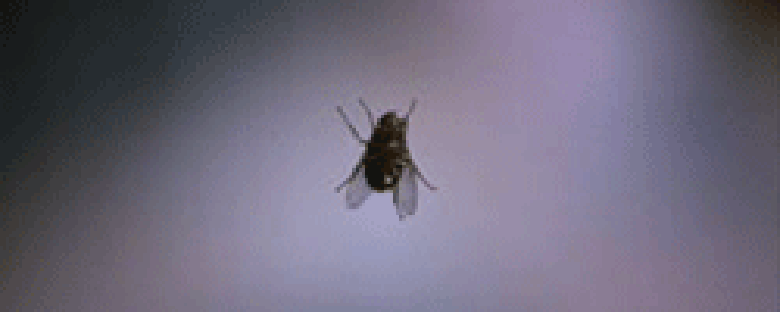
David Cronenberg’s early preoccupation with the flesh has been well documented. In Rabid he explored the concept that flesh is both integral to the self and yet able to rebel against it, in The Brood it was the ability of the flesh to reproduce itself, and the uncertain outcome of such an event. Scanners depicted the mind fighting back against bodily dominance, while Videodrome examined the introduction of technology to the human equation, imagining a world where machines and bodies become fused, creating a ‘new flesh.’ Cronenberg’s obsession reached its feverish conclusion in his 1986 remake of The Fly, taking all of these different variations on a single theme and splicing them into a single, faultless whole.
This metaphor of splicing opposes other aspects of the production. The screenplay effortlessly blends genres—horror, romance, sci- fi, tragedy, even comedy. It is a film which rises above humble beginnings, taking the most basic outline of the original ‘50s film — man merges with fly in bizarre scientific accident — and seamlessly integrating modern preoccupations: sex and death, ageing and loss of self, love and the death of love. In the process it becomes so much more than the original, an epic tragedy in 90 minutes, one of the finest love stories ever committed to celluloid and the best American horror movie of the ‘80s.
Cronenberg is consistently undervalued as a writer. His early screenplays tended to allow characterisation to be overwhelmed by drama and sociological concerns, but there is a significant development from Scanners onward, a level of humanity that brings the films to life. His screenplay for The Fly is quite simply perfect, striking a precise balance between compassion and exploitation, humour, terror and abject revulsion.
The film builds mercilessly. The opening scenes are all about character, as journalist Veronica Quaife allows herself to be picked up by gawky scientist Seth Brundle at a reception dinner for Bartok Industries, a classically Cronenbergian, shadowy R&D conglomerate. But already the tension is building, almost imperceptibly; who is this Brundle, and what does he want? He’s a nerd, a boffin, but never a cliché—there’s no lab coat here, no bubbling test tubes, and his seduction of Veronica, though inept, is undoubtedly effective. Seth is in many ways the archetypal Jeff Goldblum role, all tics and sideways humour, loveable but somehow unsettling. And Geena Davis, too, was never better—the two leads were an item when the film was shot, and it shows; there’s genuine chemistry in this relationship.
But there’s also real sweetness. The romantic aspects of The Fly tend to be forgotten in the face of later horrors, but Seth and Veronica’s relationship is a model of onscreen love: tentative at first, then passionate, as she opens him up to a world of new experiences, teaching him about the flesh. His bookish uncertainty — ‘Is this a romance we’re having? Is that what this is?’ — and his sense of excitement are infectious and honest; this feels real. Which of course only serves to make the collapse of their relationship, and of Brundle himself, all the more upsetting.
The degradation of Brundlefly has been claimed as a metaphor for just about every form of human suffering going. The film was made at the outset of the AIDS scare, and Brundle’s unstoppable decline does in some ways mirror the onset of that disease. But it could just as easily be any other fatal, debilitating illness—cancer is even directly mentioned, as a disease with a purpose, turning Seth into Brundlefly, a new lifeform. So in fact the disease metaphor is not entirely accurate; Seth is not dying, merely changing. He has in effect been dead since the moment he stepped from the pod and became a new being. So perhaps the film works better as a metaphor for transformative experiences, albeit not necessarily positive ones—dangerous, unpredictable transcendence. The boyfriend who begins to exhibit violent tendencies. The woman unable to commit fully to her chosen partner. The unborn child whose very existence tears a family apart, or reunites them—in the final scene the grotesquely malformed Brundlefly attempts to fuse himself with Veronica and her baby, creating the perfect family, man wife and child in one body.
The fact that so many interpretations are possible shows the skill and depth of Cronenberg’s work as scriptwriter. There is a scene near the end of the film, as Veronica confronts Seth in the final stages of his transformation. Their conversation begins with bleak humour — “the Brundle museum of natural history” — before moving on to sociology — “Have you ever heard of insect politics?” — and philosophy — “I am an insect who dreamed he was a man…” — ending with one of the coldest, most threatening lines of straight horror dialogue in the film: “I’ll hurt you if you stay.” Veronica’s responses become our own: revulsion and pity, fear and confusion. The work of the actors and makeup technicians is extraordinary, but it’s the dialogue that makes the scene, which provokes such deep and conflicting emotions.
The finale of The Fly has to be one of the most emotionally extreme in mainstream cinema. Brundlefly’s body fuses with the prototype telepod, forming a creature that is part human, part fly and part machine, begging for death. The scene is claustrophobically terrifying and yet somehow operatic, even cathartic, blanketed in smoke and dry ice. Veronica’s nervous collapse is devastatingly real as she murders her mutant lover in a shower of neon sparks. And here the film ends; there is no more to say. A crescendo, then silence.
More than any of his other works, The Fly explores Cronenberg’s conflicted feelings about flesh—it is desirable, rebellious, unpredictable, dangerous and beautiful, and will eventually be the death of us all. But there is also a sense of moving on, of laying old obsessions to rest and discovering a new fascination with human relationships in all their complexity, laying the groundwork for the next phase of his development as a filmmaker, the psychological terrors of Dead Ringers, Crash and Spider.
We don’t do comments anymore, but you may contact us here or find us on Twitter or Facebook.