


Reviews

Paul Thomas Anderson
USA, 2007
Credits
Review by Jenny Jediny
Posted on 16 December 2007
Source Paramount Vantage 35mm print
The path to progress is one strewn with victims, a consequence traditionally accepted in history books; we read accounts of the casual yet lethal accidents that occurred during the construction of Transatlantic railroads, or of factory workers exhausted and racked with illness during the endless shifts of the Industrial Revolution, all in the name of man’s progress. Revisionists magnify the plights of these anonymous masses, providing minute details of their suffering while distorting the glorification long attached to the men who dreamt up such projects. While fictionalizing history, There Will Be Blood is fully aware of the approach of the latter’s view of the past, embarking on the disintegration the self-made man, that heralded image all too symbolic in American mythology, and the trampling effect of those in power.
While Upton Sinclair’s Oil! - upon which There Will Be Blood is sourced - has a socialist bent and concerns issues of government scandal in the Nineteenth Century oil industry, Paul Thomas Anderson’s film is less broad, and avoids political rhetoric. Anderson’s filmmaking is unquestionably distinct, but his previous films have been excessive for my tastes, both in craft and theme. Two of these frequented themes - familial relationships and theological musing (at play, bluntly, throughout Magnolia) - have been retained here, but with newfound restraint. Admittedly, There Will Be Blood seems a perfect balance between excess and restraint, as Anderson establishes a sprawling history while maintaining concentrated intimacy with his characters.
While weaving in aspects of capitalism and corruption, Anderson pulls the story into focus around the solitary figure of Daniel Plainview, a tenacious oil prospector. In portraying Plainview, Daniel Day-Lewis exhibits nuances of the period with obsessive perfection, from the physical gait of his character to his theatrical speech pattern; it’s an enthralling performance, but what Day-Lewis manages to convey psychologically about Plainview is rattling by the film’s conclusion. While wealth is the superficial aim, Plainview is far more interested in power, and the control that it affords. There is a brief moment where Plainview tells a young girl that her father won’t be beating her anymore, now that he has essentially taken over their community. The girl’s father, in clear earshot, has no choice but to acknowledge his subordination to Plainview, who clearly relishes in his own influence, with little regard for the child. As Plainview gains power, however, he is only unnerved by even the slightest threat to his domain.
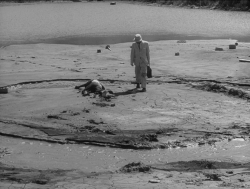
It would be shallow to suggest that Plainview is merely a sociopath, as it is unclear if this behavior existed all along; we only meet Plainview as he is initially striking into the oil industry, with little knowledge of his past. Symbolically, the film manifests Plainview’s fixations into oil and blood; the two fluids combine when Plainview injures himself in his first digging expedition. It’s a telling moment, as Plainview, clearly in distress from a leg injury, drags himself not to safety, but instead to examine the rocks he’s discovered that indicate oil beneath the surface. Perhaps this moment, as oil literally oozes into his wounds, is the catalyst for his resulting obsession—for the remainder of the film, nothing, and no one, will come between Plainview and his oil.
Blood continues to spill throughout the film, and while much of it flows from dead bodies, there is also the sort that binds men together. Plainview not only acquires wealth in his initial oil expedition but also a son, H.W., who becomes his young business partner. Anderson’s father figures are regularly of the worst variety, and he is no less kind here in establishing Plainview, who uses his son’s cherubic face to charm his clients. Yet a complexity is carved into the relationship between Plainview and H.W.; while Plainview seems to keenly value his son as a miniature model of himself, there is an implication of love as well, as contaminated as it may be. It’s perhaps the film’s greatest tragedy that Plainview cannot bring himself to be a better father, as there is clearly something broken inside this man. A monologue nearly halfway through the film reveals that what Plainview may seek is relief in a brotherly bond, knowledge that someone aside from himself feels such a desperate disconnection from other men; this inability to connect only brings forth guilt and resentment toward H.W., feelings that develop after sudden misfortune that seems to be the turning point for Plainview, a plunge into self-loathing that results in eccentric madness.
Although Plainview does seek kinship, both in his adopted son and blood relatives, the brotherly attention he receives from the church is in no means wanted. In the undeveloped West, the only competition for a successful oilman might have been the church, in terms of gaining public faith and devotion, and Plainview meets his adversary in Eli Sunday, a young evangelical minister. It’s such a widely recognized rivalry, but also a perfect embodiment of hypocrisy between capitalism and the church, and Plainview pits himself against Eli with great fervor. The power struggle between both men is at times humorous, but never without the hint that it could precariously fall into disastrous consequence. As time passes, and Eli grows older and more resentful of Plainview’s purposeful mocking, their relationship turns deadly, as each attempts to exploit and expose the other’s weaknesses.
There Will Be Blood is replete with bangs and whimpers, both literally and poetically, but it is also comfortable with silence. The film opens with Plainview silently digging through muddy earth in search of his fortune—this is accompanied only by the brief squall of wailing, ear-piercing strings from Jonny Greenwood’s score. The music here is abrasive, composed of diegetic sound translated into pizzicato, or mimicking psychological distress, and while not atonal, echoes composers such as Penderecki or Bartok. Robert Elswit’s color palette mutates from oil-black nightscapes to honey-toned fields—there are certainly touches of a Terrence Malick landscape here, as there is technically superb camerawork. Oil drips on the camera lens, there are elegantly composed long takes, and a particularly jaw-dropping sequence of fire on an oil derrick. On a smaller, but personally important note, the cast looks as though they walked out of late nineteenth century photographs, not merely giving There Will Be Blood the distinction of feeling like an exquisite period piece, but sealing this world into an epochal part of America’s past while echoing strains of our present state of progress. Occasionally it feels as if little has altered, that greed is no less overpowering today than it was nearly a century ago, and that little separates church and state; rather they remain intertwined in what feels like malignant co-dependency.
There Will Be Blood is as frightening as it is engrossing; with a single viewing I felt a bit shell-shocked, if giddy, while the second was far easier to absorb, and to take note of the smaller details that remain in my mind like a well-written novel. While it’s obvious great films remain visually in the mind, it’s rare for me to run through a film afterwards not merely for what I have seen, but as if it had been vividly written onto the screen. There Will Be Blood feels bigger than the sum of its parts, perhaps the first film in some time to capture such a sprawling piece of American history. Inevitably the film concludes on the human wreckage that is the casualty of such expansion, and the ruin of the soul in pursuit of power. Possessed and poisoned by his incessant need for control, perhaps Plainview has received what he seemed to want all along, but not without great cost; at the end of his self-made war, he truly is a finished man.
We don’t do comments anymore, but you may contact us here or find us on Twitter or Facebook.