


Reviews

Sergei Dvortsevoy
Kazakhstan, 2008
Credits
Review by Timothy Sun
Posted on 13 October 2008
Source 35mm print
Categories The 46th New York Film Festival
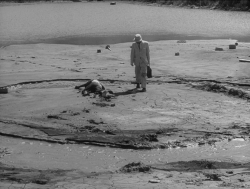
This year, the New York Film Festival likes to begin its screenings with a famous quote from Jean-Luc Godard: “Cinema is truth 24 times a second.” What they don’t mention is the second part of the quote: “And every cut is a lie.” By that criteria, Sergei Dvortsevoy’s startingly accomplished debut dramatic feature, Tulpan, is about as true as it gets. Clearly drawing on his background as a documentarian, Dvortsevoy creates a picture that is at once tightly controlled and seemingly caught on the fly. In long, unbroken takes, the camera doesn’t so much follow the characters as observe the landscape; the characters simply move in and out of the frame. The mise en scene alternatives between the ascetic and the elaborate, sometimes nothing more than the endless stretch of the Kazakh steppe and other times crammed full of people, donkeys, sheep, wind and dust, all either moving in carefully planned confluence with the camera or simply set in motion and somehow captured within the frame – the magic of this film is you can never tell. In this story of Kazakh steppe sheep herders, the land, the animals and the people are all inextricably linked, each given equal attention by Dvortsevoy’s gently probing camera.
Tulpan is Kazakh for “tulip,” and is also the name of the girl Asa, a returning sailor-turned-sheep herder living with his sister’s family, hopes to marry. Their courtship seems out of a feudal history book, a series of parental negotiations and gift-giving. Tulpan herself is glimpsed, fleetingly, only once by Asa, and never by the audience. She is a flower in the desert, a mirage representing all of Asa’s aspirations for a better life. But she is more than a mere symbol; she is a young woman with desires of her own - to go to college, to live in the city, to escape from the poor life her parents and her parents’ parents have struggled through for generations. When she rejects Asa for having big ears, we know that it is not big ears but small dreams that Tulpan finds unattractive.
Asa is, for all of his fantasies of future success, a country boy, tethered to the land and to his family. His idea of the good life is a herd of his own, satellite TV in his yurt, and flowers that bloom through the dust. This puts him at odds with his peers, whether it be Tulpan or his friend Boni, who blasts pop music from his car and spends his free time cutting out magazine spreads of bare-breasted women. Asa’s is an anywhere-but-here generation, instantly familiar to anyone who has ever grown up in a small town, only most of us do not have to give birth to sheep. This generational divide between the young who want out and the old who know of nothing else lends the film an elegiac quality, a sense that all of the beautiful images we have seen - a lightning storm churning out of a blue-gray sky, cyclones that appear out of nowhere and then disintegrate back into nothingness, the humbling and near-mystical span of a 360 degree horizon line disappearing into the distance - will soon be cast away from the human gaze and left to remain undisturbed for eternity.
Dvortsevoy is as adept at grand scale filmmaking as silent intimacy; indeed, much of the power of the film comes from making the small as epic as the vast landscape that contains it. Toward the end, when harsh reality has killed Asa’s dream of marrying his tulip, he quietly draws a flower in the sand, a picture as ephemeral as the dream itself. Dvortsevoy shows us this image suddenly and nonchalantly, as if his roving camera had just happened upon it. Its beauty and simplicity is literally breathtaking - the gasps I heard in the audience made it seem like Peter O’Toole had just blown out the match and we cut to a 70mm shot of the desert.
The apotheosis of Dvortsevoy’s formal style – the elegant yet improvisational long take, the melding of the simple and the grand – comes with the film’s central set piece: an unbroken 10-minute shot of a sheep giving birth. Never has the miracle of life looked so truly miraculous on screen. Asa’s panic as he tries to pull the lamb out of the womb is palpable, the weight of all that has come before – an earlier birth sequence, the rampant dying of others in the herd, Asa’s incompetence, his dashed hopes and the uncertainty of his future – settling on this single transcendent scene. It is sublime, but even after witnessing this ultimate expression of hope and, later, Asa’s fateful decision (which I will not reveal), the future remains as fretful as ever. I left the movie excited by discovering a new cinematic voice but heavy with the feeling that, like the final shot of the film, this is a way of life that is slowly drifting away into a cloud of dust.
More The 46th New York Film Festival
-

Wendy and Lucy
2008 -
The Northern Land
2008 -

The Last Command
1928 -

Hunger
2008 -

Lola Montès
1955 -

Summer Hours
2008 -

Gomorrah
2008 -

Changeling
2008 -

Che
2008 -

I’m Gonna Explode
2008 -

Waltz with Bashir
2008 -

Happy-Go-Lucky
2008 -
The Windmill Movie
2008 -

Tulpan
2008 -

Afterschool
2008 -

A Christmas Tale
2008 -

The Headless Woman
2008 -

Bullet in the Head
2008 -

Four Nights with Anna
2008 -

Night and Day
2008 -

The Class
2008
We don’t do comments anymore, but you may contact us here or find us on Twitter or Facebook.