


Reviews
Fritz Lang
Germany, 1927
Credits
Review by Rumsey Taylor
Posted on 14 March 2014
Source Kino Video DVD
Categories Silent Lang
It is no task to relay the many strengths of Fritz Lang’s Metropolis. Even in its age, the film possesses a certain mastery, replete with cinematographic innovations and imagination. It remains, justly, a formidable tentpole within cinema’s robust and varied history. I am inclined to forward these familiar laurels, for in viewing the film some seventy years following its inception supplies unexpected criticisms.
The titular city is divided vertically, into several layers that partition social strata: the aristocracy on the day-lit surface; the working class beneath the ground, employed in ten-hour shifts; and the king at the top of the towering Ziggarnaut. The film opens with a routine shift change in a subterranean factory. The locale is filled with complicated equipment (an abstract montage of close-ups of moving gears introduces the sequence). A whistle alarms, a block of workers enter the factory, and an equally proportionate group exits. The men move in robotic choreography, and are identical in dress.
The workers are largely indistinguishable from the factory that houses them. This is a visual pun that relays the dependency between man and his machine. Furthermore, the centerpiece of the factory is a device that resembles a clock. A worker assigns his hands to its, and must manipulate its movement accordingly—without the human operator, the device is useless; likewise, the machine is a necessity in Metropolis’ operation. Shaped circularly, it is a target at which man converges with machine.
Although Metropolis is more concerned with socio-politics than science, a criticism for scientific dependency is apparent. The film contains a wild-eyed scientist determined to bestow life to a machine—it is a familiar scientific motif, that the creator must face the responsibility of creation and in doing so prescribe upon himself the curse of hubris.
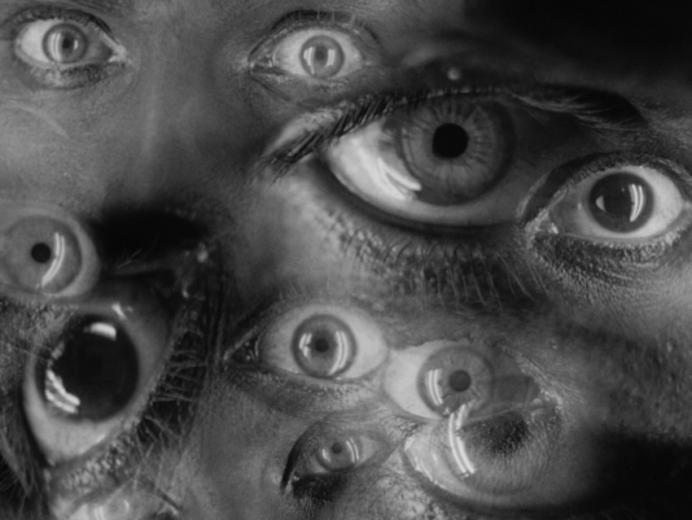
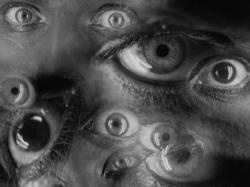
The scientist’s creation is a robot that, upon completion, resembles a flesh-and-blood woman. She has no moral consciousness, and invites pronounced lust in the men that see her—in effect, compromising their own morality. In one of the film’s many virtuosic sequences she dances wildly as a concubine, and reaction shots find close-ups of the glaring, hypnotized eyes of men.
The intent of the scientist mirrors the dehumanizing purpose of the underground factory. Each is a surrogate extension of the same thought: that science and nature are burdened by their union, and will result in caustic repercussions. At the beginning of the film, these elements are balanced, and will conflict once the division between the upper and lower class - between technology and free will - is contested.
In the tiers above the workmen is the Eternal Gardens, a leisure for the children of Metropolis’ wealth. Freder, the son of the city’s king, flirts with a woman until his eyes are distracted by the entrance of Maria, a rebel spokesman for the working class. On this particular day, Maria is leading a group of the workmen’s children into the garden. Freder, borne of his father’s political standing and wealth, falls instantly for Maria, who lives among her like in the city’s sewers. Their differentiated status prohibits any interaction.
Their relationship humanizes the central conflict of Metropolis. I speculate that this relationship is deliberately facile, for it is effective only in respect to the plot mechanics. The film combines other familiar narrative devices: Frankensteinian hubris, religious martyrdom, and the transcendent and redemptive power of true love. None of these aspects are treated with subtlety; the propagandistic slogan that opens the film (“The Mediator between the Head and Hands must be the Heart!”) is reinforced by the machine that enables the factory operation—it is named the “heart.”
There are several shots in Metropolis, met by highlights in the scoring, that linger statically on a wide view of the city’s active horizon. These shots I viewed like a hawk. Though its fabrication is obvious, Metropolis has an enduring visual strength.
More Silent Lang
-

Harakiri
1919 -
The Spiders
1919 -
The Wandering Shadow
1920 -
Destiny
1921 -

Four Around the Woman
1921 -

Dr. Mabuse the Gambler
1922 -
Die Nibelungen
1924 -
Metropolis
1927 -
Spies
1928 -
Woman in the Moon
1929
We don’t do comments anymore, but you may contact us here or find us on Twitter or Facebook.