

Reviews
Frederick Wiseman
USA, 1974
Credits
Review by Leo Goldsmith
Posted on 08 June 2008
Source Zipporah Films VHS
Categories Frederick Wiseman
In the accompanying ideology, animals are always the observed. The fact that they can observe us has lost all significance. They are objects of our ever-extending knowledge. What we know about them is an index of our power, and thus an index of what separates us from them. The more we know, the further away we are.
—John Berger, “Why Look at Animals?”
If places are the stars of Frederick Wiseman’s films, then the people within them often seem like the extras. This is a consistent criticism of his work: that his films often seem to “observe” situations in detail, but rarely allow a sense of what’s “really” going on in the characters minds, rarely allowing them to explain themselves, their context, their motivations. Almost always, Wiseman’s characters are quite literally anonymous. We see only their public selves - and only snatches of these selves, at that - and are left as viewers to try to identify with or else remain alienated from them. In this way, Wiseman does for the documentary film what Brecht did for the stage: divesting it of the need for an illusory verisimilitude, for an immersion of the audience in an experience, and prioritizing its social utility as a means of conveying information. But of course, as with Brecht, this is not to suggest that the filmmaker merely convey information, least of all in any simple or objective sense.
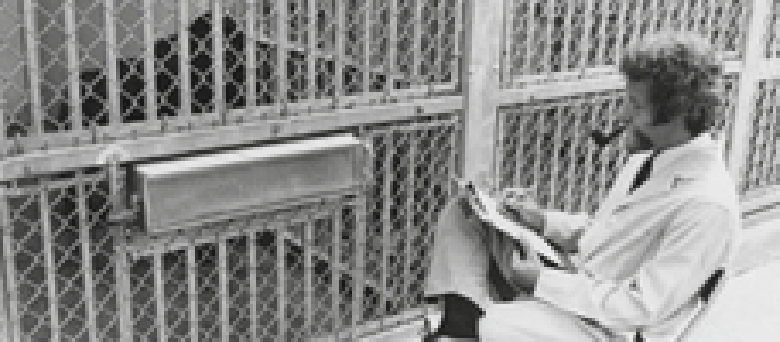
Wiseman’s 1974 film Primate serves as a useful corrective to those who would still describe the filmmaker’s cinema as “direct.” First, with its assertive, masterful use of montage, it represents a new formal complexity in Wiseman’s work as an editor. From the opening sequence - a rapid, rhythmic succession of portraits of notable scientists, an exterior shot of Emory College’s Yerkes National Primate Research Center, and then a large, standing gorilla - the viewer discerns a particular voice, a conspicuous point of view, if not exactly an agenda or intent. But second, Primate also examines subject matter that is the most extreme Wiseman had approached since his first film, Titicut Follies—extreme not only in the sense of its often harrowing images, but also in its intricate configuring (and re-configuring) of the spectator’s identification.
Indeed, one of the principal oddities of Primate - and indeed there are many - is how frequently and how precisely it echoes Wiseman’s debut film. The grim, prison-like atmosphere of the research center and its panoptical structure of both confinement and observation are obvious correlations, but certain events documented in the film border eerily on self-reference. In one sequence, a monkey’s stomach contents are extracted through a tube inserted into the animal’s nose; in another, a gorilla is shaved and cut open. Once it undergoes an unnamed surgery, it is then deposited in its cell where it groans in a curiously human way. Indeed, one of the strange correlations between the two films is how closely the subjects of each resemble those of the other: The inmates are powerless objects of study and what often appears to be abuse, while their captors effect an austere, professional, and largely unsympathetic manner.
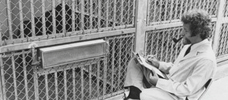
What’s particularly striking about this dynamic between inmate and scientist, particularly in light of Wiseman’s earlier film, is that it continually problematizes our perspective as viewers. With whom are we to identify: primate or researcher? Both, or neither? Indeed, the very title of the film is something of a pun, referring as much to the apes in the cages as to those in the lab coats, who smoke pipes and take notes on the sexual habits of their captors. In a series of hilariously deadpan exchanges, researchers engage in a lot of earnest talk about animal copulation—some occasionally betray a small chuckle at the discussions of simian ejaculate and how best to extract it, but more often they assume an air of banality and clinical detachment:
MALE PRIMATOLOGIST: … And there’s an erection.
FEMALE PRIMATOLOGIST: A nice erection.
MALE PRIMATOLOGIST: Yeah, a pretty good size one.
As the researchers force the animals to have sex for their observation, or coerce them into a series of increasingly mystifying and violent experiments, the spectator might wonder which of the figures onscreen seems the more human: the animals that are unwillingly shunted from cell to experiment, screeching wildly, or those who mechanically note the animals’ every reaction into voice recorders for the benefit of science.
While some of experiments depicted in the film are entirely harmless and occasionally even benevolent, the majority of research is nebulous in its intent and becomes, as the film progresses, increasingly difficult to watch. By far the most notorious scene in Primate is that in which a squirrel monkey - which, by an unfortunate coincidence is among the smallest and cutest of the primates featured here - is dragged from its cage, drugged, and effectively scalped. Alive but insensate, the animal is methodically and minutely dismembered, its skull hollowed, and its remains discarded. Depending on your perspective (and perhaps your knowledge of primate research), this scene may be either fascinating or unbearably appalling, and its inclusion in the film has led to a great deal of controversy, not so much for its content as what may be deemed its lack of contextualization. Yerkes’ director, Dr. Geoffrey Bourne, has claimed that Wiseman’s film is misleading in that it fails to specify the point of experiments such as this one, an analysis of the monkey’s optical nerve system.
But in a sense, the film does give the researchers an adequate forum to explain their intentions. Halfway through film, there is that most anomalous of occurrences in a Wiseman film: a scientist explaining his work directly to the camera. Later still, Wiseman features a roundtable discussion, in which a group of primatologists champion the utility of seemingly “useless knowledge,” even going so far as to liken their work to the inadvertent discovery of penicillin. “All research is useful,” says one of the scientists, “even though its usefulness is not apparent at the time it’s done.”
For the defender of animal research, this argument and its lucid presentation in the film ought to serve well enough. And yet, it seems clear - though it is by no means conveyed imposingly - that Wiseman remains skeptical or at least unconvinced. But then Wiseman’s job, in a sense, is to observe the observers. Itself a kind of primate research, Primate captures the researchers’ own instinctual behavior: a pursuit of knowledge for its own sake, at the expense of the lives and wellbeing of the animal subjects, that is often brutal, relentless, and even absurd. In a stunning and witty final sequence, Wiseman follows the researchers onto a U.S. Air Force cargo jet used for astronaut training. A rhesus monkey is confined to a Perspex contraption and sent into the stratosphere so that the scientists can study its reactions to zero-gravity conditions. In the final shot, the monkey sticks out its tongue.
More Frederick Wiseman
-
Titicut Follies
1967 -

High School
1968 -
Law & Order
1969 -
Basic Training
1971 -
Juvenile Court
1972 -
Primate
1974 -
Welfare
1975 -
Meat
1976 -
Sinai Field Mission
1978 -
Manoeuvre
1979 -
Model
1980 -

The Store
1983 -

Blind
USA -

Adjustment & Work
1986 -

Missile
1987 -

Central Park
1989 -

Near Death
1989 -

Aspen
1991 -
Zoo
1993 -

High School II
1994 -

Ballet
1995 -
La Comédie-Française
1996 -

Public Housing
1997 -
Belfast, Maine
1999 -

Domestic Violence / Domestic Violence 2
2001 / 2002 -
The Last Letter
2002 -

State Legislature
2006
We don’t do comments anymore, but you may contact us here or find us on Twitter or Facebook.